
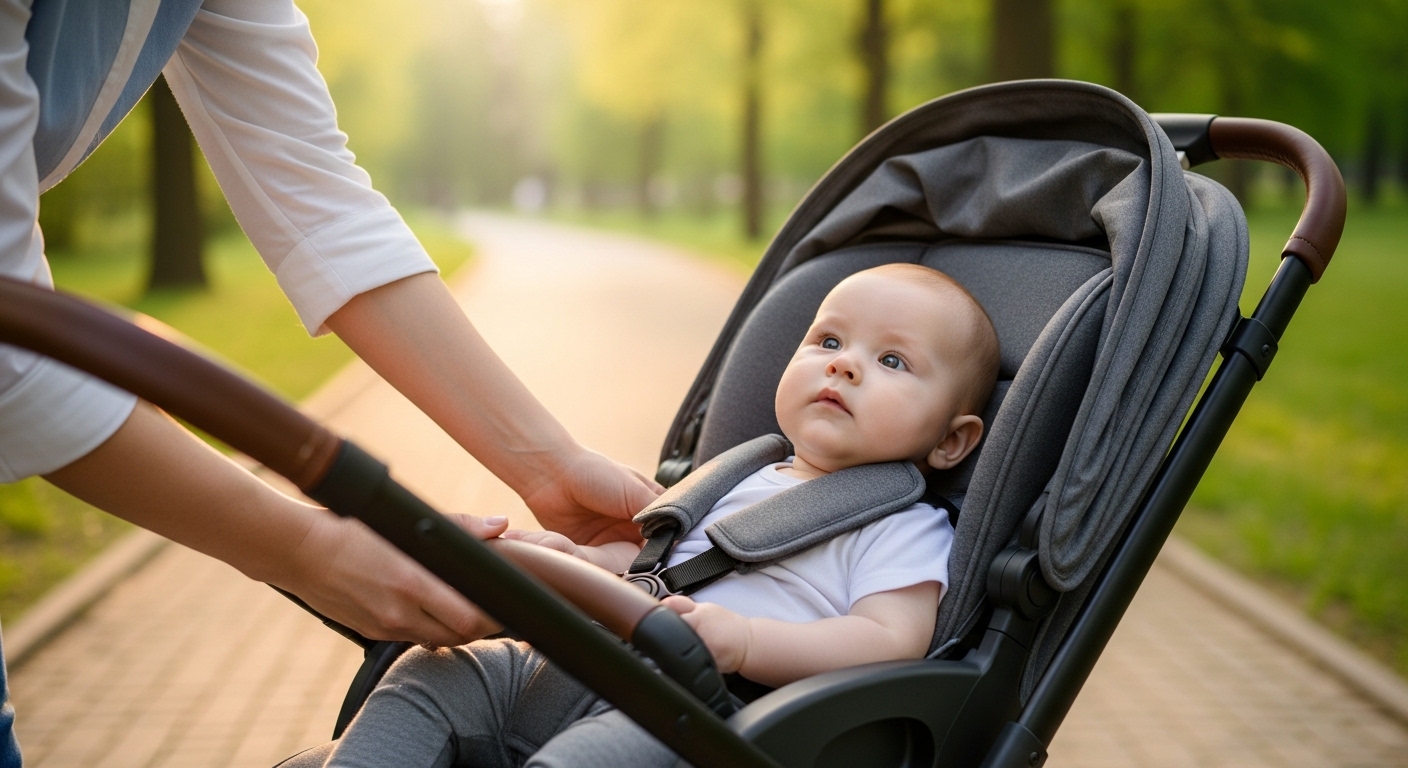
You’ve probably caught yourself wondering when can baby ride in stroller while standing there, maybe staring at your newborn who still feels too tiny for… well, anything that moves faster than your heartbeat, and yeah, that hesitation? it’s real, not just you overthinking stuff.
It’s one of those questions that seems simple, but then suddenly splits into ten more—like, is it safe already, do I need a special stroller, what if their neck flops, what if people judge me (they wont, but still). So let’s untangle this properly, in a way that feels like someone actually talking to you, not lecturing.
The Short Answer (But Not The Full Story)
Technically, babies can ride in a stroller from birth—but, and this is a big but, not just any stroller, and definitely not in any position you feel like trying out randomly.
Newborns don’t have proper neck control yet, which means their head kinda just… does its own thing if not supported. So what matters isn’t just when, it’s how. A stroller that fully reclines flat, or one that supports a bassinet-style attachment, is what you’re looking for in those early days.
And yeah, people sometimes say “I took my baby out at two weeks and it was fine,” which might be true, but babies aren’t copy-paste versions of each other. Yours deserves a setup that fits them, not someone else’s Instagram moment.
Newborn Stage: 0 to 3 Months
This is the phase where everything feels fragile, and honestly, that instinct isn’t wrong.
At this stage, your baby needs:
- Full head and neck support
- A flat or near-flat lying position
- Minimal jolting or bumpy movement
Best Stroller Options for Newborns
- Bassinet stroller: Feels like a tiny bed on wheels, which sounds odd but works perfectly
- Fully reclining stroller seat: Must go completely flat, not “almost flat”
- Travel system (car seat + stroller): Super common, and pretty convenient
Here’s a quick comparison that might help you sort it out without spiraling too much:
| Stroller Type | Suitable From Birth | Key Benefit | Limitation |
|---|---|---|---|
| Bassinet Stroller | Yes | Ideal flat sleeping position | Bulkier, less portable |
| Travel System | Yes | Easy car-to-stroller transition | Not for long naps |
| Standard Stroller | Sometimes | Versatile for later stages | Needs full recline feature |
A small thing people forget—babies shouldn’t stay in car seats for too long outside the car. It’s not dangerous instantly, but long durations can affect breathing posture a bit, which pediatricians do mention.
As the American Academy of Pediatrics advises, extended time in semi-upright devices should be limited for newborns.
Around 3 to 6 Months: Things Start Changing
Now things get interesting, because your baby starts gaining strength, slowly but noticeably, like one day they just decide “hey, I can hold my head now.”
This is when stroller use becomes easier, but still not totally carefree.
Most babies around this age:
- Begin holding their head steady
- Show curiosity about surroundings
- Tolerate semi-reclined positions
What You Can Do at This Stage
You can start using:
- A partially reclined stroller seat
- Forward or parent-facing positions (though many still prefer seeing you)
- Shorter strolls that gradually get longer
But here’s the catch—just because they can sit a bit, doesn’t mean they should sit upright for long. Their spine is still developing, and pushing them into full seating too early is like asking a sapling to hold itself in a storm… not ideal.
6 Months and Beyond: The “Okay, This Is Fun” Phase
This is usually when parents finally relax a little, because baby is stronger, more stable, and honestly more entertaining during walks.
At around 6 months, most babies:
- Sit with minimal support
- Have strong neck and upper body control
- Enjoy looking around instead of sleeping all the time
Stroller Freedom (Almost)
Now you can:
- Use standard stroller seats fully upright
- Switch to lightweight or umbrella strollers
- Go on longer walks, even rougher paths (within reason)
Still, keep an eye on comfort. Just because they aren’t crying doesn’t always mean they’re comfy—babies are weird like that, they’ll tolerate something slightly annoying for longer than expected.
Signs Your Baby Is Ready for a Stroller
Instead of obsessing over exact age, look for these signs, they matter more than numbers:
- Holds head up steadily
- Doesn’t slump forward when seated
- Seems curious, not overwhelmed, outdoors
- Can tolerate being in one position for a bit
If you’re checking those boxes, you’re probably good to go, even if your baby isn’t exactly “on schedule.”
Safety Tips You Shouldn’t Ignore (Even If They Sound Obvious)
Some of these feel like common sense, but you’d be surprised how easy it is to skip them when you’re tired.
- Always use the harness, even for “just a minute”
- Avoid uneven, super bumpy terrain early on
- Don’t hang heavy bags on stroller handles (they tip, fast)
- Keep sun exposure limited, especially under 6 months
- Check weight and age limits on your stroller model
And yeah, the harness thing—people skip it all the time, until the one time they shouldn’t have.
Common Mistakes Parents Make
You’re not alone if you’ve already done one of these or thought about it:
- Using a stroller that doesn’t recline fully for a newborn
- Letting baby sleep too long in a car seat attached to a stroller
- Switching to upright seating too early
- Assuming all strollers are newborn-friendly
There’s a weird assumption that if it’s sold as a stroller, it must be safe for all babies, but that’s not really how it works. Each model has its own limits, and ignoring them can quietly cause issues.
What About Jogging Strollers?
Short answer: not yet, at least not in the early months.
Jogging strollers are built for movement, speed, and shock absorption—but even then, they’re not suitable for newborns.
Most experts recommend waiting until:
- Baby is at least 6 to 8 months old
- Has full neck and head control
- Can handle slight jolts safely
Even brands like BOB Gear and Baby Jogger mention similar guidelines in their manuals.
Real-Life Scenario (Because Theory Only Goes So Far)
Let’s say you have a 2-week-old baby, and you’re desperate to step outside for your sanity. Totally valid, by the way.
You could:
- Use a bassinet stroller for a gentle walk
- Keep it short, maybe 15–20 minutes
- Avoid crowded or noisy areas
Now compare that to a 7-month-old baby:
- You’re strolling through a park
- Baby is upright, looking around, maybe babbling
- You’re actually enjoying it, not just worrying
Same activity, completely different experience, just because of timing and setup.
Final Thoughts That Actually Matter
So, when can baby ride in stroller? Honestly, sooner than you think—but only if the stroller supports your baby the way their tiny body needs right now.
It’s less about hitting a specific age milestone and more about respecting how fast (or slow) your baby develops. Some babies are ready earlier, some take their sweet time, and both are perfectly okay.
If you take anything from this, let it be this: choose the right stroller setup first, then let your baby grow into it naturally. Not the other way around.
And yeah, you’ll probably still second-guess yourself a little before that first walk—but once you’re out there, moving, breathing, seeing your baby just… exist in the world, it kinda clicks into place, awkwardly but beautifully.

Thomasjames is a stroller expert blogger sharing honest reviews, practical guides, and parenting tips, helping families choose safe, comfortable, high-quality baby strollers with confidence.