
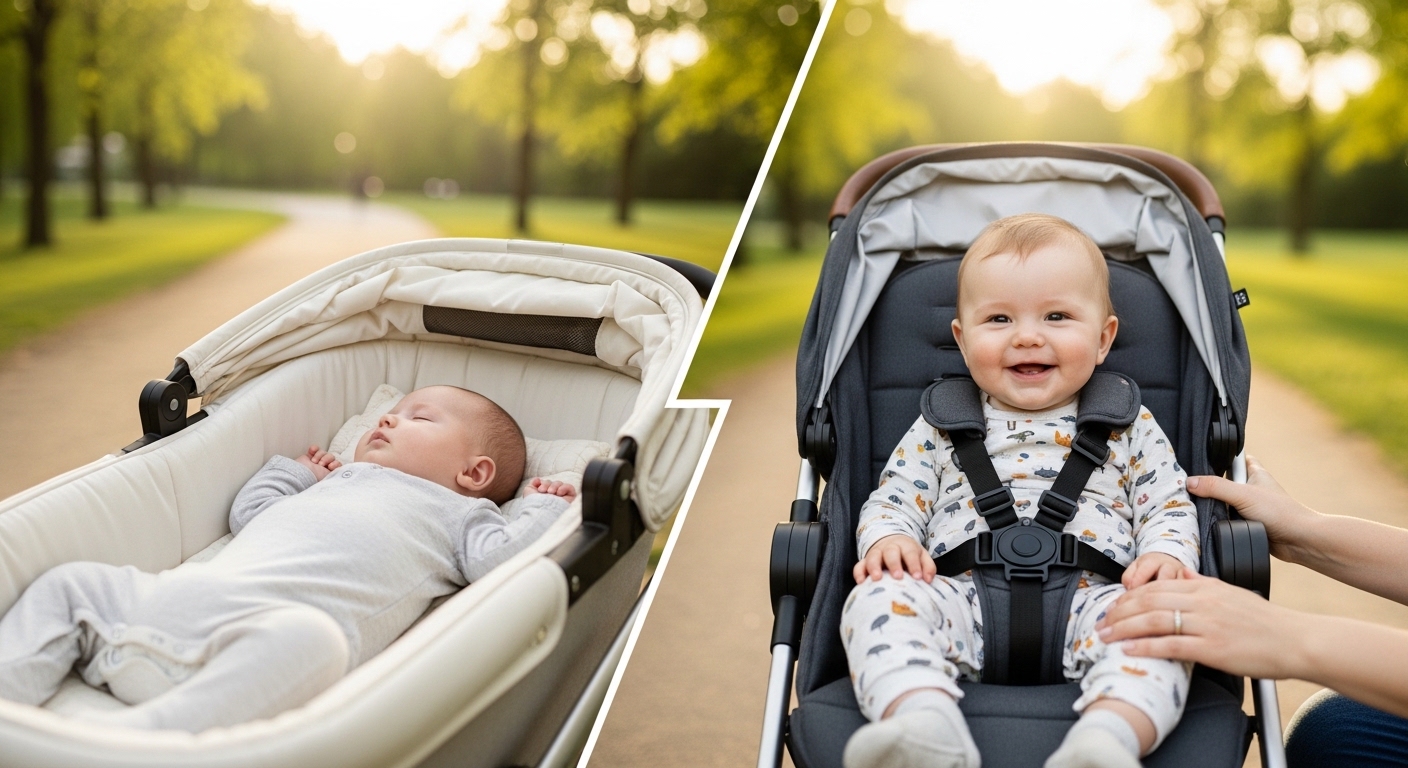
When to switch from bassinet to stroller seat is something you start wondering about right when your baby begins looking a bit too long for that cozy flat space, and honestly it just sneaks up on you one random walk outside when everything feels suddenly cramped. You’re pushing the stroller and thinking “wait… is this still okay?” while your baby is either stretching like they own the place or trying to twist their little head up more than you’d expect.
And yeah, that moment feels confusing because there’s no loud signal that says it’s time, just small changes that slowly pile up until you can’t ignore them anymore.
What the bassinet phase is really doing for your baby
In the early weeks, a bassinet attachment is basically a tiny mobile bed. Your baby lies flat, spine supported, breathing easier in a natural position. Newborns don’t have strong neck control yet, so this flat position matters more than people think.
Most bassinets are designed for babies from birth up to around 3–6 months, but that range isn’t strict. It depends more on development than the calendar. Some babies outgrow it mentally before physically, others physically before you expect it.
Doctors generally agree on one idea: flat lying is safest for newborns because it supports airway alignment and reduces strain. The American Academy of Pediatrics has long recommended flat sleeping surfaces for infants to reduce risks linked with unsafe positioning.
But then, babies don’t read guidelines, right? So they grow in their own messy timeline.
When to switch from bassinet to stroller seat (real signs, not just age)
If you’re waiting for a magical “correct week,” you’ll probably miss it. The better way is to look for signs your baby is telling you indirectly.
Here are the most common real-world signals:
- Baby’s head or feet are touching both ends of the bassinet
- They start lifting their head or trying to sit up during walks
- Rolling or side-leaning becomes frequent
- They seem uncomfortable or fussy in the flat position
- Weight limit is approaching (often around 9–11 kg depending on stroller model)
Some parents also notice a behavior shift. The baby becomes more alert and wants to see around instead of lying flat staring at fabric walls.
At that point, the stroller seat isn’t just optional, it starts becoming more practical.
Age vs development: what actually matters more
People love to say “switch at 4 months” like it’s a fixed rule, but that’s kinda misleading. Age is just a rough marker, not a decision tool.
Here’s a more realistic breakdown:
| Age Range | Typical Stage | Bassinet Use |
|---|---|---|
| 0–2 months | Mostly sleeping, minimal head control | Ideal use |
| 2–4 months | More alert, starting head control | Still fine but transitioning begins |
| 4–6 months | Strong neck control, curiosity increases | Many babies outgrow bassinet |
| 6+ months | Sitting with support, very active | Stroller seat preferred |
What really matters is neck strength and body control. Once your baby can hold their head steadily without wobbling, you’re already near the transition zone.
The biggest safety reason for switching
Here’s the part most parents don’t think about at first: bassinets are only safe while the baby stays fully flat and contained.
Once your baby starts trying to lift or push up, the bassinet can become less ideal because:
- They might strain themselves trying to sit
- Movement can reduce stability inside the bassinet
- Space becomes limited, increasing discomfort
- They may roll slightly to one side if active
Stroller seats are designed differently. They support semi-upright positioning with harness systems that keep the baby secure even when they get wiggly.
A simple way to think about it:
Bassinet = sleep and flat rest
Stroller seat = awake time and controlled sitting
Signs you’re probably delaying the switch too long
Sometimes parents wait a bit too long because bassinets feel safer emotionally. That’s normal, but there are signs you shouldn’t ignore.
If you notice:
- Baby constantly looks cramped or curled
- They wake up more often during walks
- Their legs are pressed or bent unnaturally
- They try to lift shoulders repeatedly
- They cry only when placed in bassinet but calm in arms
Then yeah, the stroller seat might actually be more comfortable already.
It’s a bit ironic, but sometimes “upgrading” the seat improves sleep too, because they feel less restricted.
How to switch from bassinet to stroller seat smoothly
This transition doesn’t need to be dramatic. You don’t just flip a switch one day and never go back. It’s more like easing into it.
Try this approach:
- Start with short stroller seat sessions at home or nearby walks
- Use a reclined position at first (most seats allow it)
- Keep outings short until baby adjusts
- Observe posture and breathing comfort
- Gradually increase time in seat
Some babies adapt in a day, others take a week or two. There’s no “wrong speed” here, just observation.
Common mistakes parents make during the transition
This part is actually more important than people admit.
1. Switching too early
If baby still has weak neck control, stroller seat can feel overwhelming and unsafe in upright positions.
2. Switching too late
Waiting too long can make outings uncomfortable for the baby, especially if they’re clearly outgrowing the bassinet.
3. Ignoring recline settings
Many parents forget stroller seats can recline. You don’t need to go fully upright immediately.
4. Not using proper harness adjustment
Loose straps are a common issue. The seat only works safely when fitted correctly.
5. Assuming all babies follow the same timeline
This is the biggest one. One baby may switch at 3 months, another at 6. Both can be completely normal.
What pediatric guidance generally suggests
Pediatric guidance usually circles around development milestones rather than strict age cutoffs.
A commonly accepted idea in pediatric care is:
- Babies should stay in flat positions while neck control is developing
- Upright seating is safe once head control is stable
- Transition should match physical readiness, not pressure or convenience
One pediatric sleep safety principle often repeated is that infants should not be placed in positions that compromise airway alignment or encourage slumping. That’s the core logic behind bassinet recommendations.
Stroller seat readiness checklist
If you’re still unsure, this simple checklist helps:
- Baby holds head steady without support
- Baby shows curiosity about surroundings
- Bassinet feels physically tight
- Baby tolerates semi-upright positions
- Weight limit is near or reached
- Walks feel smoother in upright position
If you tick 3 or more, you’re probably already in transition territory.
Real-life parent observation (what actually happens)
Most parents don’t switch in one clean moment. It’s usually messy.
One day the bassinet feels perfect. Next week the baby starts kicking more. Then suddenly the same bassinet looks like a tight sleeping drawer instead of a cozy bed.
And then you try the stroller seat once… and the baby just looks around quietly like “oh so this is the world now.”
That’s usually the moment it clicks.
Final thoughts on when to switch from bassinet to stroller seat
There’s no perfect calendar date hiding somewhere. The real answer sits in your baby’s behavior, posture, and comfort. Once the bassinet stops matching their physical growth and curiosity, the stroller seat becomes the natural next step.
And honestly, you’ll probably feel it before you even fully decide it. It’s one of those parenting shifts that’s less about rules and more about noticing small changes that suddenly feel big.
You’re not looking for perfection here, just comfort, safety, and a setup that actually fits the baby you have today, not the newborn you had a few months ago.

Thomasjames is a stroller expert blogger sharing honest reviews, practical guides, and parenting tips, helping families choose safe, comfortable, high-quality baby strollers with confidence.